Tips to Prevent Holiday Weight Gain in Dogs (Singapore Edition)
In Singapore, “holiday season” doesn’t just mean Christmas. We’ve got feasts rolling from Christmas to New Year, Chinese New Year, etc..
More gatherings = more food on the table… and often, more food “accidentally” landing in your dog’s mouth. Over time, those extra bites add up.
Excess weight in dogs is linked with joint problems, arthritis, diabetes and a shorter lifespan.
The goal isn’t to be the Grinch of dog treats. It’s to help your pup enjoy the celebrations and keep a visible waistline.
1. Know Your Dog’s Rough Daily Calorie Needs
Every dog is different, but it helps to know a rough daily calorie budget.
Using standard veterinary formulas and tools like the Pet Nutrition Alliance calorie calculator, a healthy, neutered adult dog with average activity often falls roughly in this range:
Dog’s weight Approx. daily calories (kcal/day)*
4.5 kg (10 lb) ~300–350 kcal
9 kg (20 lb) ~500–575 kcal
13.5 kg (30 lb) ~700–800 kcal
23 kg (50 lb) ~1,000–1,150 kcal
32 kg (70 lb) ~1,300–1,500 kcal
*These are estimates. Puppies, very active dogs, seniors and dogs with medical conditions should follow your vet’s advice.
If you want a more precise number, you can use the Pet Nutrition Alliance dog calorie calculator.
2. Follow the 10% Treat Rule (90/10 Rule)
Most veterinary and pet nutrition guidelines recommend that no more than 10% of your dog’s daily calories come from treats and “extras” – the other 90% should come from a complete, balanced diet.
That includes:
Biscuits and jerky
Dental chews
“Just a bit of bak kwa”
“One small pineapple tart only”
Steamboat meats from reunion dinner, etc.
Food for Thought
A 9 kg (20 lb) dog needs ~525 kcal/day (roughly).
10% for treats = about 50 kcal/day.
90% (about 475 kcal) should be from their usual dog food.
If each treat is 10 kcal:
3 x biscuits = 30 kcal
1 x small chew = 20 kcal
Total = 50 kcal → treat budget maxed out.
Treats should replace some of your dog’s usual food – not just be added on top.
3. Balance Treats With Meal Portions & Exercise
a) Cut back the main meal to “make space” for treats
Practically, this might look like:
Dog usually eats 2 cups of kibble per day.
On days with lots of treats, feed around 1¾ cups instead of 2 cups.
Measure with a proper measuring cup, not a random spoon.
b) Add movement – but don’t rely on walks alone
Dogs in Singapore may not get long hikes, but we do have conveniently-located dog runs, park connectors, and late-night void deck strolls.
Exercise is great, but you usually can’t out-walk a big calorie surplus. Instead, include little movements as part of the day:
Add one extra 10–15 minute walk if your dog is fit enough.
Replace a treat with their main meal or sniffing games (scatter a few kibbles in the grass, let them sniff and find).
Get family involved – take a walk as a family after dinner.
4. Use a Body Condition Score (BCS) Chart, Not Just the Scale
You may not have a scale at home, but you’ve always got your hands and eyes. Take note of how visible your dog’s waist and ribs are before the holiday season and make a mental note to check on it after the busy feasting period is over.
Vets often use a 9-point Body Condition Score (BCS) system:
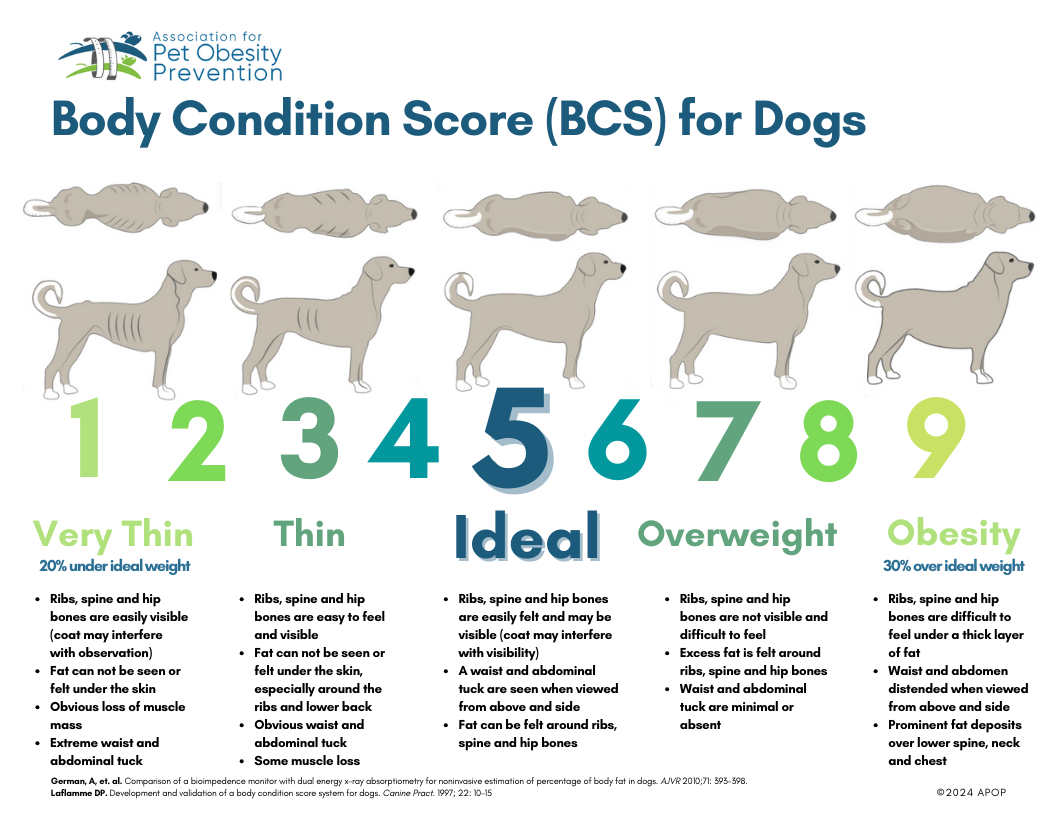
Image from Association for Pet Obesity Prevention.
5. Choose Healthier, Lower-Calorie Treats
You don’t have to stop treating completely – just choose lower-calorie options and keep portions small. Veterinary nutrition resources often recommend safe fruits and vegetables as training treats for suitable dogs.
Always check with your vet if your dog has medical issues, but for many healthy dogs, you can suggest:
Crunchy, low-calorie snacks
Cucumber cubes
French beans (blanched, plain)
Small carrot coins (still contain sugar, so in moderation)
Zucchini slices
Simple proteins
Tiny pieces of plain boiled chicken or turkey breast (no skin, seasoning, onion or garlic).
Small flakes of plain white fish (no batter, no salt).
Cooling frozen treats (nice for SG weather)
Ice cubes made from low-sodium broth (onion- and garlic-free).
A few pieces of frozen cucumber or green beans.
And of course avoid common toxins: chocolate, grapes/raisins, xylitol, alcohol, onions, garlic, etc.
If Your Dog Still Ends Up a Bit Chubby…
Realistically, between gatherings, reunion dinners and endless snacks, some dogs will come out of the holidays slightly rounder.
The important thing is that owners notice early and respond gently.
Re-check your dog’s BCS.
Go back to measured portions and the 10% treat rule.
Swap some higher-calorie snacks for lighter options like cucumbers or green beans.
Add a little extra movement where your dog is fit enough – an extra spin around the block, a slightly longer park walk, or more playtime.
If your dog is already quite overweight, or has joint, heart or other medical issues, it’s always worth checking in with your vet for a safe, structured weight-loss plan.
At the end of the day, your dog doesn’t care whether it’s Christmas, CNY or just a random Tuesday – they just want to feel good, move comfortably and hang out with their favourite human (that’s you).
So enjoy the celebrations, plan the treats, and keep an eye on that cute little waistline.
